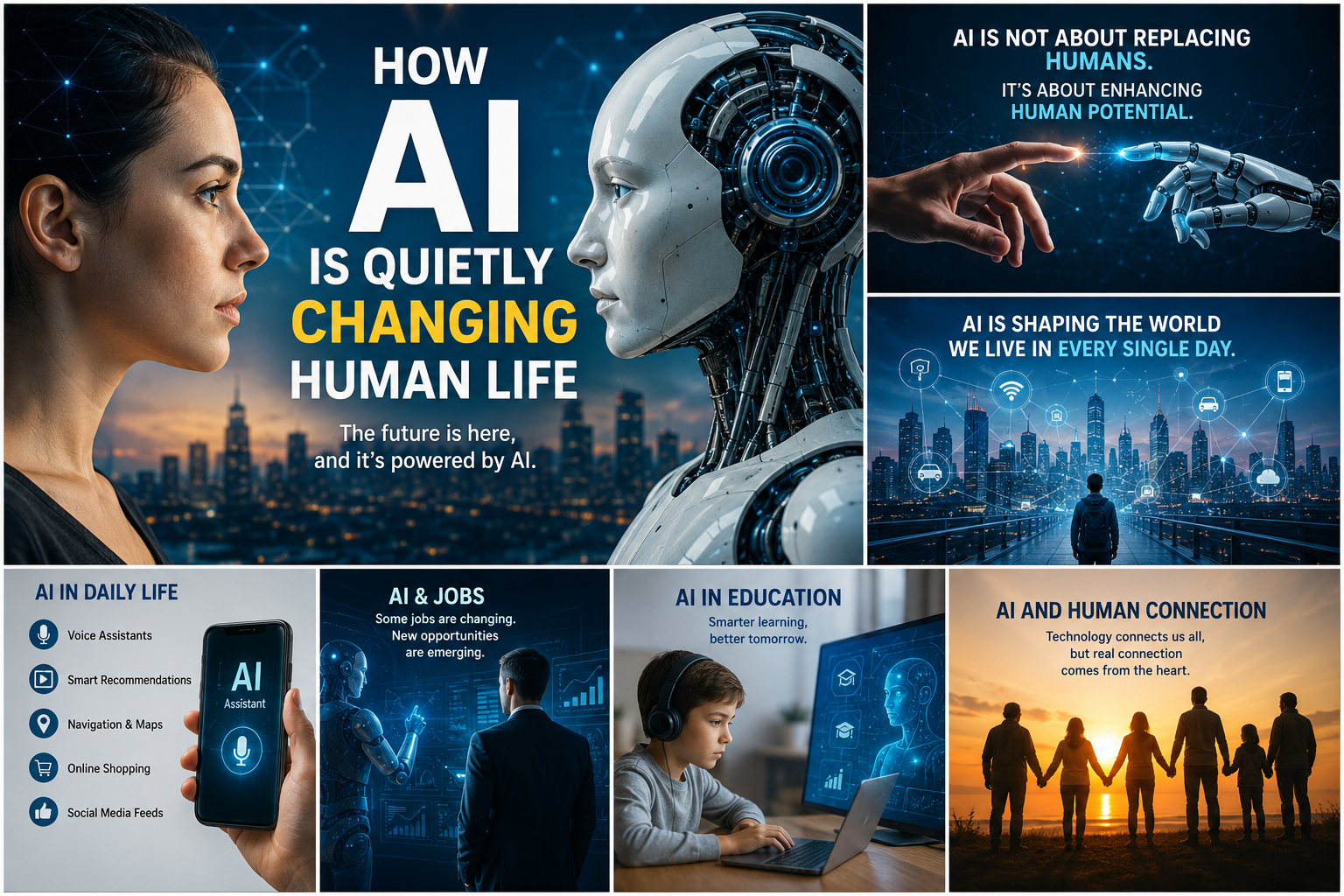
How AI Is Quietly Changing Human Life in 2026
Technology has always changed the world, but no invention in modern history is transforming human life as quickly and silently as Artificial Intelligence. A few years ago, AI sounded like a futuristic concept from science fiction movies. Today, it is everywhere — in our phones, social media feeds, online shopping apps, schools, hospitals, workplaces, and even in the conversations we have every day.
Most people use AI without even realizing it. Every time Netflix recommends a movie, Spotify suggests a song, or Instagram shows a reel that perfectly matches your interests, AI is working behind the scenes. It studies behavior, predicts choices, and learns from millions of users every second. Slowly and quietly, AI has become part of modern human life.
But this transformation is bigger than convenience. AI is changing the way humans think, work, communicate, and even feel emotions. Some people believe it will create a smarter future full of opportunities. Others fear it could replace jobs, reduce human creativity, and make society emotionally disconnected. Whether we like it or not, one thing is certain: humanity is entering a completely new era.
AI in Everyday Life
The most interesting thing about AI is that it no longer feels like a machine. It feels natural. Voice assistants answer questions instantly, navigation apps predict traffic before we leave home, and online stores know what we want before we search for it.
Social media platforms are perhaps the strongest example of AI influence. Algorithms study what users watch, like, comment on, and share. Based on this information, platforms create highly personalized feeds designed to keep attention for as long as possible. This is why people often feel trapped in endless scrolling without realizing how much time has passed.
AI also powers translation tools, customer service chats, facial recognition systems, and smart devices in homes. Even education has changed dramatically. Students can now learn through AI tutors, instant summaries, personalized study plans, and automated problem-solving tools.
Life is becoming faster, easier, and more connected because of AI. Tasks that once took hours can now be completed in minutes. However, convenience often comes with hidden consequences.
The Changing World of Jobs
One of the biggest discussions around AI is employment. Across the world, companies are using automation to reduce repetitive work. Machines can now analyze data, answer customer questions, generate reports, write content, create designs, and even produce music and videos.
Many traditional jobs are slowly changing. Cashiers are being replaced by self-checkout systems. Customer support teams are increasingly assisted by AI chatbots. Factories use robots for manufacturing, while software automates office tasks that once required large teams of workers.
This creates fear for millions of people. Students wonder whether their future careers will still exist. Employees worry about becoming replaceable. Governments and companies are trying to adapt, but the speed of AI development makes the future uncertain.
At the same time, AI is also creating new opportunities. Careers in data science, AI development, cybersecurity, robotics, digital marketing, and content creation are growing rapidly. The future may not belong to people who compete against AI, but to those who learn how to work with it.
Human skills such as creativity, emotional intelligence, leadership, communication, and critical thinking are becoming more valuable than ever. Machines can process information quickly, but they still struggle to fully understand human emotions, empathy, and imagination.
AI and Human Relationships
Perhaps the most unexpected effect of AI is its influence on human relationships. Technology connects people instantly, but many experts believe it is also creating emotional distance.
Social media algorithms often encourage comparison and validation. People spend hours chasing likes, views, and followers. Online interactions sometimes replace real conversations. As AI learns how to capture attention more effectively, digital addiction becomes harder to escape.
Some people now talk more to AI assistants than to real humans. AI companions and chatbots are becoming emotionally advanced, capable of holding conversations, giving advice, and simulating empathy. While this can help lonely individuals, it also raises important questions.
Can technology replace human connection?
Will future generations become emotionally dependent on machines?
What happens when people trust algorithms more than real relationships?
These questions are no longer science fiction. They are becoming part of daily reality.
Education in the Age of AI
Education is changing faster than most people expected. In the past, students depended mainly on textbooks and teachers. Today, AI tools can explain concepts instantly, generate practice questions, summarize chapters, and create personalized learning experiences.
This has many advantages. Students can learn at their own pace, access information from anywhere, and improve weak subjects more efficiently. AI also helps teachers manage large classrooms and automate repetitive tasks.
However, there are concerns as well. Some students rely too heavily on AI-generated answers instead of developing real understanding. Creativity and problem-solving skills may weaken if technology does all the thinking.
The challenge for modern education is balance. AI should become a tool for learning, not a replacement for human intelligence and curiosity.
The Mental Health Impact
Although AI makes life easier, it can also increase stress and anxiety. Constant notifications, endless information, and algorithm-driven content overload the human brain. Many people feel mentally exhausted without understanding why.
The pressure to stay connected all the time affects concentration and emotional health. Studies suggest that excessive social media use can contribute to loneliness, low self-esteem, and depression, especially among young people.
AI algorithms are designed to maximize engagement, not necessarily happiness. They show content that triggers emotional reactions because emotional content keeps people online longer. This creates a cycle of distraction and overstimulation.
At the same time, AI is also being used positively in mental health care. Some apps help users track emotions, practice meditation, and access therapy support. AI-powered tools can detect signs of emotional distress and offer early intervention.
Like every technology, AI itself is not purely good or bad. Its impact depends on how humans choose to use it.
Creativity and the Future of Art
One of the most fascinating developments in AI is its ability to create art, music, videos, and writing. AI-generated paintings can look realistic. Music tools can compose songs within seconds. Writers use AI to brainstorm ideas and generate content faster than ever before.
This raises an important debate: if machines can create art, what makes human creativity special?
Some artists fear AI will reduce the value of human work. Others believe AI can become a powerful creative partner. Instead of replacing imagination, it may expand possibilities and help creators experiment in new ways.
The future of creativity may involve collaboration between humans and machines rather than competition.
The Future Ahead
No one knows exactly how AI will shape the next twenty years. Some experts predict a future filled with medical breakthroughs, smarter cities, safer transportation, and improved quality of life. Others warn about privacy risks, job displacement, misinformation, and growing dependence on technology.
What is clear is that AI will continue evolving rapidly. The decisions humans make today will determine whether AI becomes a tool that empowers humanity or one that controls it.
Society must learn how to balance innovation with ethics. Governments need responsible regulations. Schools must prepare students for a changing world. Individuals must learn digital awareness and emotional balance.
The future is not simply about machines becoming smarter. It is about humans deciding what kind of world they want to build alongside those machines.
Conclusion
Artificial Intelligence is no longer a distant dream. It is already transforming everyday life in ways many people do not fully notice. From jobs and education to relationships and creativity, AI is influencing nearly every aspect of modern society.
The world stands at an important turning point. Technology has the power to improve human life dramatically, but it also carries risks that cannot be ignored. The challenge is not stopping AI — because that is impossible. The real challenge is learning how to use it wisely while protecting what makes us human.
In the end, the future of AI may not depend on machines at all. It may depend on whether humanity can remain thoughtful, creative, compassionate, and emotionally connected in a world increasingly shaped by algorithms.