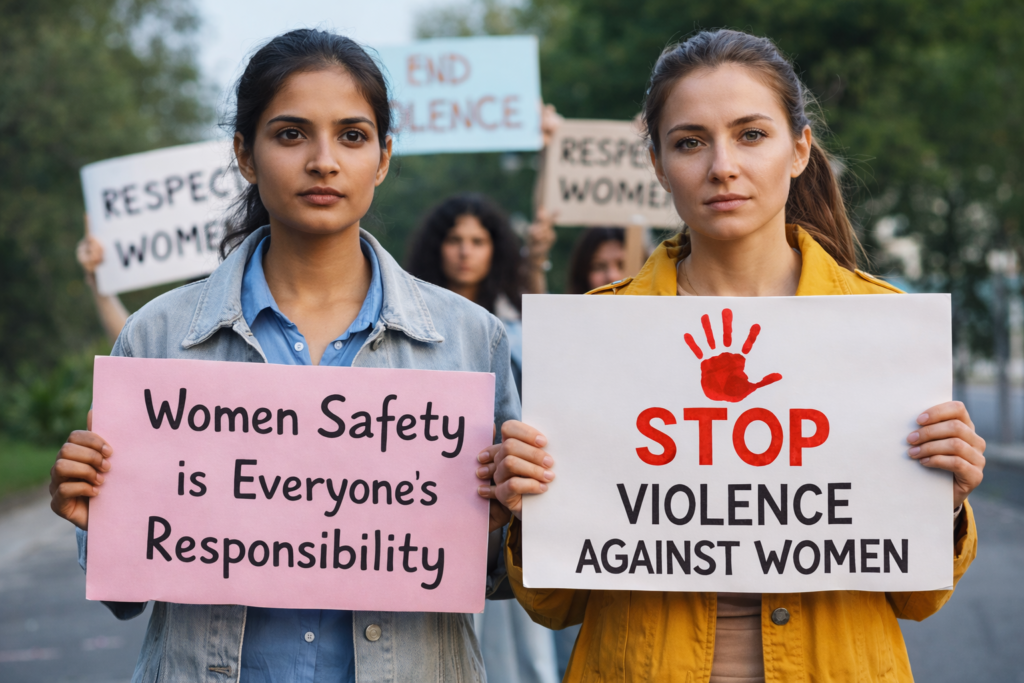
Women Safety: A Responsibility We All Share
Women safety is not just a women’s issue. It is a societal responsibility. Every woman deserves to feel safe — at home, at school, at work, on the streets, and online. Safety is not a privilege. It is a basic human right.
Yet, in many parts of the world, women still think twice before stepping out alone at night. They share live locations. They hold keys between their fingers. They avoid certain streets. They stay silent about harassment to avoid “trouble.”
This reality needs to change.Safety begins with awareness. Families must teach boys and girls equally about respect, boundaries, and consent. Often, conversations focus only on protecting girls. But true change comes when we educate boys to respect women, understand personal space, and treat everyone with dignity.Schools and colleges should also create safe environments. Clear anti-harassment policies, awareness workshops, and proper complaint systems are essential. When institutions take complaints seriously, women feel empowered to speak up.Public spaces must be safer.
Proper street lighting, CCTV cameras, safe public transportation, and quick-response helplines can reduce risk significantly. Governments and local authorities play a major role here, but citizens also contribute by being alert and responsible.Technology has both helped and harmed women’s safety. On one hand, safety apps, emergency contacts, GPS tracking, and SOS features offer protection. On the other hand, online harassment, cyberbullying, and stalking have increased.
Digital safety is equally important. Women should:Avoid sharing personal information publiclyUse strong passwordsBe cautious of unknown messagesReport online harassment immediately
At the same time, social media platforms must strengthen policies against abuse and harassment.But beyond systems and technology, mindset matters most.Many times, when incidents happen, society questions the woman instead of the offender. “What was she wearing?” “Why was she out late?” “Why was she alone?” These questions shift blame in the wrong direction.The responsibility of safety should never fall on the victim.Clothing does not cause harassment.
Time does not cause harassment. Freedom does not cause harassment. Lack of respect does.Women should not have to shrink themselves to feel safe.Empowerment also plays a role in safety. Self-defense training, awareness of rights, and confidence-building programs help women protect themselves physically and mentally. Knowing how to react in unsafe situations can make a difference.However, self-defense is not the ultimate solution. The ultimate solution is cultural change.
Respect must be taught at home. Children learn from observing adults. If they see equality and mutual respect in their homes, they grow up carrying those values.Workplaces must maintain zero tolerance toward harassment. Safe reporting systems, strict action policies, and supportive environments are necessary.
Women should not feel afraid of losing opportunities if they raise their voices.Communities must support survivors instead of judging them. Silence protects offenders. Support empowers victims.Men also have a powerful role in women’s safety.
Speaking up against inappropriate behavior, challenging sexist jokes, and standing beside women in public situations are simple yet strong actions. Real strength lies in protecting dignity, not threatening it.Women safety is also linked to economic independence. Financially independent women have more freedom to leave unsafe environments. Encouraging education and career opportunities for women strengthens society as a whole.
When women feel safe, they contribute fully — in business, education, leadership, science, arts, and every field.A safe society benefits everyone.It is important to remember that fear should not control a woman’s life. Safety measures are important, but so is confidence. Women should walk with strength, speak with courage, and live without apology.
We must build a culture where daughters are raised without fear and sons are raised with respect.Change does not happen overnight. But it begins with small actions:Teaching consentListening without judgmentReporting harassmentSupporting survivorsCreating safe spacesEvery voice matters. Every action counts.
Women safety is not about restricting women. It is about restricting harmful behavior.It is about creating a world where women do not have to plan their lives around safety concerns. Where freedom is normal. Where respect is natural. Where dignity is guaranteed.
A truly developed society is not measured only by technology or economy. It is measured by how safe its women feel.Let us work toward a world where safety is not a daily concern but a basic reality.Because when women are safe, society is strong.